 Sportbet.one
  EveryGame
  Bovada
  MyNitro
  Betcoin.ag
  BetUS
BetUS 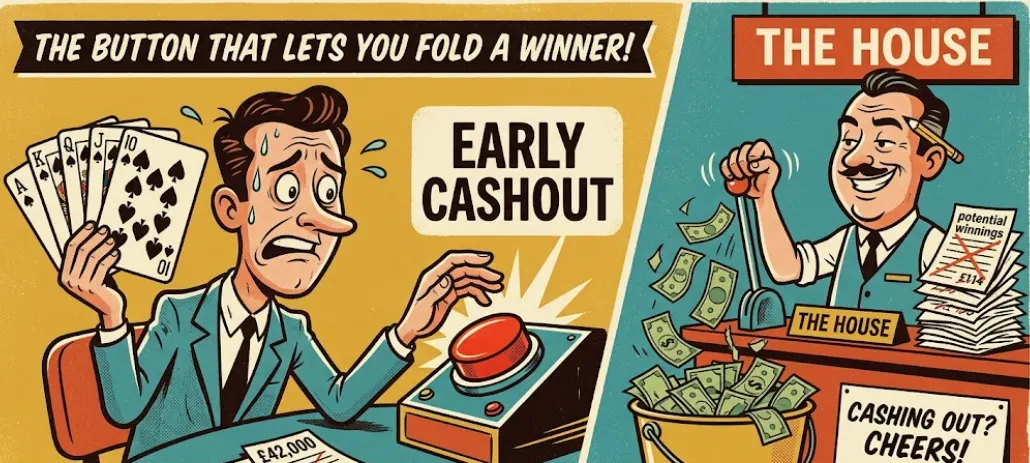
Early cashout is the feature sportsbooks introduced to give bettors "control," which is a lovely word that usually means the opposite of what it says. It lets you close a live bet before the final whistle, either to lock in profit, claw back some stake, or occasionally make a decision so regrettable it will haunt you through three marriages. It is, without question, the most emotionally charged button in sports betting.
Below is our list of cashout-friendly online sportsbooks that our editors have reviewed and vetted. Highly recommended:
What Early Cashout Actually Is (And Why It Exists)
A cashout offer is the sportsbook's real-time bid for your open ticket. They calculate the current probability of your bet winning, multiply it by your potential payout, and then quietly shave off a margin for the house. The industry formula is roughly this: offered cashout = (potential winnings ÷ live odds) × (1 − vig). The vig there is not a small number. On a cashout, you're often paying juice on top of juice, because the vig was already baked into the original odds when you placed the bet.
Put it this way. If your $100 bet at even money now has an 85% chance to win, the true expected value of that ticket is $170. The book will cheerfully offer you $140 and call it fair. That $30 gap is the insurance premium for your peace of mind, and the books love it, because they've built a business out of selling anxiety relief to people who placed the bet in the first place.
There are three flavors you'll see:
Full cashout. You close the whole ticket for the offered amount. Clean exit, final answer.
Partial cashout. You take a slice off the top and let the rest ride. Useful on parlays when you want to guarantee a profit but still have skin in the final legs.
Auto cashout. You set a trigger. Bet hits $X, it closes automatically. Think of it as a stop-loss for your parlays, except the loss is a loss of potential upside.
The Mathematics Nobody Wants to Hear
Here's the uncomfortable truth. Over a long enough sample, early cashout is a losing proposition for the bettor. The books aren't offering it because they're generous. They're offering it because the built-in margin on cashouts is higher than the vig on a standard straight bet, and it turns ambiguous outcomes into guaranteed book profits.
A standard point spread at -110/-110 has a house hold of about 4.8%. Cashout offers, depending on the book and the volatility of the moment, can carry margins pushing 8% to 12% or higher, especially on live markets, parlays, and futures where pricing is harder and bettors are less likely to shop around. Live betting vig is already elevated because of the speed and the information asymmetry. Stack a cashout margin on top of an already-juiced live line, and you're volunteering to pay the house twice for the privilege of being nervous.
The Infamous Lincoln City Acca
In March 2026, a punter placed a £5 fifteen-fold accumulator at odds of 8,590.48/1. Norwich won. Southampton won. Lincoln won. Bromley won. The ticket was alive and humming. Full payout would have been around £42,000. The bettor got spooked somewhere along the way and cashed out for £114.
The reactions on social media were exactly what you'd expect, ranging from sympathetic ("£109 profit though, good man") to apoplectic ("why put a big bet on like that if you're gonna cash"). The answer, of course, is that humans are not wired for expected value calculations when real money is on the table and the adrenaline has kicked in. This is precisely why the button exists.
When Cashing Out Actually Makes Sense
Now, despite the math, there are legitimate reasons to press the button. The feature isn't evil. It's just expensive. Use it when:
Something material has changed that wasn't in your original model. Your starting quarterback tore his ACL on the third possession. Key injury, red card, weather delay on an over/under, manager decides to rest his starters at halftime. When the information you bet on is no longer the information in play, you weren't wrong to bet, you were wrong about the inputs. Taking a reduced return is reasonable.
You bet for entertainment and the entertainment is over. If your Sunday afternoon parlay is now one leg away from payout and the Monday night game is 16 hours of psychological torture you don't want, the vig you pay on cashout is essentially the cost of sleeping well. Some people will call this weak. Those people are also single.
The offer is surprisingly generous. Occasionally the algorithm misprices a situation. Heavy favorites drifting in live odds, slow market updates on a niche league, or a parlay where the remaining legs look worse than they did when you placed the bet. If the cashout offer exceeds what you calculate the true expected value to be, take it. This is rare, but it happens more often on smaller books with less sophisticated live pricing.
You have a huge parlay within one leg of hitting. Here's where the math bends. A 12-leg parlay down to its final leg at -200 has an implied win probability of around 66.7%. If the cashout is 70% of the full payout, you're getting better than fair value in exchange for certainty. On the rarest occasions, this calculation tips in your favor. Most of the time it doesn't, but the closer you are to the finish line on a monster ticket, the more defensible the cashout becomes as a variance reduction tool.
When Cashing Out Is Just Panic
Your bet is winning as expected. You had a read. The read is correct. The game is playing out how you thought it would. A cashout offer dangling in front of you is not new information. It's the same information priced worse. Let it ride.
You're chasing the dopamine of closing tickets. Some bettors develop a habit of cashing out every bet that goes green, which feels great in the moment and catastrophic over 500 bets. You've converted yourself from a bettor who occasionally loses to a bettor who always leaves money on the table. The long-run EV is genuinely ugly.
You didn't do the math, you just got nervous. Honest advice: if you can't articulate why the cashout offer is better than holding, don't take it. "I just have a weird feeling" is not a betting strategy. It's the same gut that made you put money on a Europa League first goalscorer at 40/1.
The Bookmaker's Quiet Trick: Cashout Suspension
One thing worth knowing. Sportsbooks reserve the right to suspend cashout any time the market gets volatile. Penalty kick, pending video review, a goal under review, technical glitch, or, more suspiciously, during the exact moments when cashout would favor you most. There's almost always a 10 to 20 second delay on cashout confirmation, during which the price can change if anything happens in the game. A goal goes in, the offer refreshes. A red card drops, the offer refreshes. You are not locked in until the book says you are.
This isn't malice, it's risk management. But it means the cashout button is not the guaranteed exit it pretends to be. If you're trying to cash out during a chaotic moment, you may find the button greyed out at precisely the point you wanted to use it.
The Best Cashout Strategy Is Not Needing It
The bettors who make long-term money rarely use cashout. They size their bets properly, they have a thesis, and they live with the outcome. Cashout is a feature designed for bettors who are either over-leveraged (stake too high for their bankroll), under-researched (bet without conviction), or emotionally invested past the point of rational decision-making.
If you size every bet so that a loss doesn't hurt and a win doesn't dominate your month, you'll press the cashout button maybe three times a year, and only for legitimate reasons. If you size bets so that every outcome is life-altering, you'll hit that button constantly, and over a year you'll have donated a meaningful percentage of your bankroll to the book purely in cashout margin.
A Short Checklist Before You Press It
Ask yourself, genuinely, before hitting the button:
Has something changed in the event that wasn't in my pre-game analysis? Is the current offer higher than my honest estimate of the bet's true value? Would I place this exact bet, right now, at the implied odds of the cashout offer? If the bet wins after I cash out, will I be annoyed for hours or fine in ten minutes?
If the honest answer to the last one is "annoyed for hours," you already know you shouldn't cash out. You just want someone to give you permission.
What Did We Learn?
Early cashout is a tool. Like any tool in sports betting, it's useful when applied correctly and ruinous when applied reflexively. The books make their margins on bettors who treat it as a comfort blanket. Smart bettors treat it as a surgical instrument, used rarely, for specific reasons, and accept the small premium when the situation genuinely warrants it.
And if you're ever about to cash out a 15-fold acca down to its final leg, just remember the Lincoln City guy. Somewhere in England, he is still staring at his ceiling at three in the morning, doing the £114 versus £42,000 math in his head. Don't be that guy. Or, if you must, at least don't tell anyone about it.