 Sportbet.one
  EveryGame
  Bovada
  MyNitro
  Betcoin.ag
  BetUS
BetUS 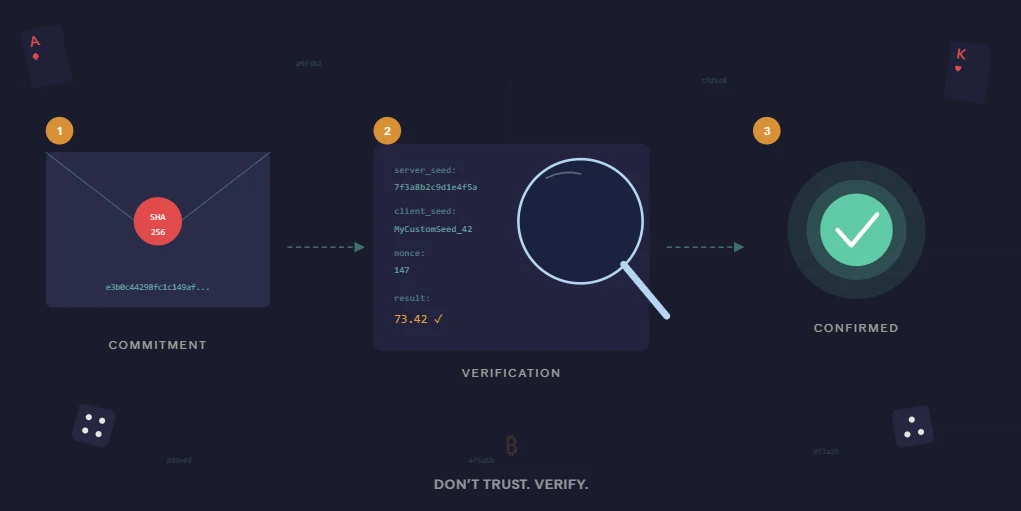
Every crypto casino on the planet now slaps "Provably Fair" on their homepage like it's a badge of honor. And technically, it is. The technology behind provably fair gaming is genuinely impressive, built on the same SHA-256 cryptography that secures billions of dollars in Bitcoin transactions every single day. But here's the uncomfortable truth that nobody in the marketing department wants you to think about: the vast majority of players who gamble at provably fair casinos have never once verified a single bet.
That's like buying a car with a dashcam and never once checking the footage after a fender bender. The whole point of the system is that you can check. So let's actually learn how to do it.
This guide will walk you through every step of verifying provably fair casino results, from understanding the cryptographic ingredients to catching the specific red flags that separate genuinely transparent platforms from those using "provably fair" as nothing more than a marketing buzzword.
What "Provably Fair" Actually Means (And What It Doesn't)
Before we get into the verification steps, let's kill a misconception that costs people money: provably fair does not mean "provably good odds." It does not guarantee fast withdrawals, honest bonus terms, or a customer support team that answers the phone. What it guarantees, when implemented correctly, is exactly one thing: the casino did not change the result of your bet after you placed it.
That's it. One thing. But it's a profoundly important thing.
Traditional online casinos use Random Number Generators (RNG) that get certified by third party auditors like eCOGRA, iTech Labs, or Gaming Laboratories International. These audits happen periodically, they test batches of outcomes, and they issue certificates. The system works, mostly. But you, the individual player, never get to verify that a specific spin or hand was genuinely random. You just trust the certificate.
Provably fair flips the model. Instead of "trust our auditor," it says "here's the math, check it yourself." The cryptographic system creates a verifiable trail for every single bet, and anyone with a web browser and five minutes can follow that trail to confirm the result was legitimate.
The technology first appeared around 2012 on early Bitcoin gambling platforms. These sites were operating without traditional regulatory oversight, and their developers needed a way to prove fairness without relying on the licensing frameworks that wouldn't touch crypto with a ten foot pole. The solution borrowed from the same cryptographic principles that make blockchain transactions irreversible: one way hash functions that commit to data before it's revealed.
The Three Ingredients Every Provably Fair Bet Uses
Every provably fair game relies on three inputs that combine to produce the result. Understanding what each one does is essential before you can verify anything.
The Server Seed
This is the casino's secret contribution to the outcome. Before your betting session begins, the casino's server generates a random string of characters. Think of it as the dealer's hidden card in blackjack, except it's a long string of letters and numbers like 7f3a8b2c9d1e4f5a6b7c8d9e0f1a2b3c.
Crucially, the casino does not show you this seed directly. Instead, it runs the seed through a SHA-256 hash function and shows you the resulting "fingerprint," a 64 character hexadecimal string. This hash acts as a commitment. The casino is essentially saying: "This is what we chose. We can't change it now, and we'll prove it later."
The reason this works is that SHA-256 is a one way function. You can hash the seed to get the fingerprint, but you cannot reverse the fingerprint to figure out the seed. Change even a single character of the original seed, and the hash output looks completely different. The National Institute of Standards and Technology (NIST) designed this algorithm to be computationally impossible to crack, and it secures everything from military communications to your online banking password.
The Client Seed
This is your contribution. Your browser generates a random string automatically, but on most platforms you can (and should) change it to something of your own choosing before you start playing. By adding your own randomness to the equation, you ensure the casino can't fully control the outcome. Even if the casino somehow knew their own server seed in advance (which they do, obviously), they can't predict what client seed you'll use. Your input makes the final result genuinely unpredictable for both sides.
Think of it this way: the casino picks half the lottery numbers, you pick the other half. Neither side knows what the final combination will be.
The Nonce
Short for "number used once," the nonce is a simple counter that starts at 0 or 1 and goes up by one with every bet you place. Its job is straightforward: making sure that even if the server seed and client seed stay the same across multiple bets, every single result is unique. Bet number 47 will produce a completely different outcome than bet number 48, even with identical seeds, because the nonce is different.
Together, these three values get fed into a cryptographic hash function (usually SHA-256 or HMAC-SHA512) to generate the game outcome. The specifics of how the hash output maps to a dice roll, card draw, or crash multiplier vary by game, but the core mechanism is always the same.
Step by Step: How to Verify a Provably Fair Result
Here's where we get practical. You've placed some bets, won some, lost more (that's gambling, after all), and now you want to check whether the outcomes were legitimate. Here's exactly how to do it.
Step 1: Find Your Bet Details
After your betting session ends, or whenever you rotate to a new server seed, head to your bet history or the "Provably Fair" / "Fairness" section of the casino. Every legitimate provably fair platform provides this. Look for a small icon, a gear symbol, or a dedicated tab near your recent bets.
You need four pieces of information:
- The server seed hash (the 64 character string you were shown before you started playing)
- The revealed server seed (the actual seed, shown only after the session ends or you request a new seed)
- Your client seed (the string your browser generated or you manually entered)
- The nonce for the specific bet you want to verify
If a casino buries this data in obscure submenus, doesn't provide it at all, or requires you to jump through hoops to find it, that alone is a red flag. A platform that's genuinely proud of its fairness system makes verification easy to find.
Step 2: Verify the Server Seed Hash
This is the most important check, and it's surprisingly simple. Take the revealed server seed (the one you got after the session ended) and run it through any free SHA-256 hash tool online. There are dozens of them. No downloads needed, no special software.
Paste the server seed into the tool. Click "Hash" or "Generate." You'll get a 64 character hexadecimal string back.
Now compare that string to the server seed hash the casino showed you before the game started. Do they match, character for character?
If yes: the casino used the same seed they committed to. They didn't swap anything.
If no: something is wrong. Either the casino changed the seed (which means they manipulated outcomes), there's a technical bug, or you copied something incorrectly. Try copying again carefully, making sure there are no extra spaces at the beginning or end. Trailing whitespace is the most common cause of false mismatches.
A real world analogy: imagine a sealed envelope handed to you before a poker game starts. The dealer says the deck order is written inside. After the game, you open the envelope and check. If the written order matches what was dealt, the game was fair. Step 2 is you opening that envelope.
Step 3: Recreate the Game Result
This part varies by game type, because each provably fair game uses a slightly different formula to turn the combined seeds and nonce into a specific outcome. A dice game might use HMAC-SHA512 to generate a number between 0 and 99.99. A card game might use the hash to determine a shuffle order. A crash game uses the hash to calculate when the multiplier stops.
Option A: Use the casino's built in verifier. Most reputable platforms, including Stake, BC.Game, Cloudbet, and BetFury, provide a "Verify" button right in the game interface. Click it, and the system automatically runs the calculation and shows you whether the result matches. It takes about three seconds.
Option B: Use an independent third party verifier. This is the power move. If you don't fully trust the casino's own verification tool (and a healthy dose of skepticism is always appropriate when money is involved), copy your server seed, client seed, and nonce into an independent verifier. Sites like provablyfair.org offer open source calculators. Several casinos also publish their algorithm source code on GitHub, meaning anyone with programming knowledge can build their own verification tool from scratch.
Option C: Calculate it manually. If you're technically inclined, you can use online HMAC generators to manually hash the inputs and convert the output. For a typical dice game, the process looks something like this:
- Calculate the HMAC-SHA512 hash using the server seed as the key and the client seed combined with the nonce as the message
- Take the first 5 hexadecimal characters of the output
- Convert those characters from hexadecimal to a decimal number
- If that number is over 999,999, skip to the next 5 characters
- Apply a modulus operation and divide to get the final roll result
Does the result you calculated match what the casino showed you during the game? If yes, the round was fair. If no, you have a legitimate complaint, and you should document everything with screenshots.
Step 4: Spot Check Strategically
Nobody expects you to verify every single bet. That would be like checking the receipt every time you buy a coffee. But you should spot check, and you should be strategic about it.
Verify the bets that hurt. Did you lose a big wager at a suspicious moment? Check that one. Did you hit a massive win streak followed by a brutal losing streak? Verify a few bets from each period. If all of them come back clean, the system is working as designed and you just experienced normal variance. If any of them fail verification, that's a serious problem.
The beauty of provably fair is that the mere possibility of checking keeps everyone honest. A casino that knows any player can verify any bet at any time has an extraordinarily strong incentive not to tamper with results. It's the same principle as security cameras in a store. Most shoplifters aren't caught by cameras; they're deterred by the existence of cameras.
What Provably Fair Cannot Protect You From
Here's where too many players get tripped up, and it's worth being blunt about it. Provably fair is powerful but narrow. It verifies one specific thing, that a game result wasn't altered after you wagered. It says absolutely nothing about the following:
House edge and RTP honesty. A provably fair dice game could have a 5% house edge built in, and every single bet would pass verification perfectly. The losses would be "fair" in the cryptographic sense but still punishing. Provably fair proves the loss was legitimate. It doesn't promise the odds were generous.
Bonus terms and wagering requirements. A casino can slap provably fair on its dice game while burying impossible 60x wagering requirements, max bet rules during bonus play, or cashout caps in the fine print. Verification won't help you when the casino refuses to pay your withdrawal because you accidentally bet $0.50 over the max bet limit during a bonus round.
Withdrawal processing. Some platforms are lightning fast. Others will hold your funds for "security review" indefinitely, especially after you've won big. Provably fair doesn't guarantee your money actually reaches your wallet.
Game coverage. Not every game at a crypto casino is provably fair. The technology typically applies to in house "original" games: dice, crash, plinko, mines, blackjack originals, and similar titles. The thousands of third party slots from providers like Pragmatic Play, NetEnt, or Play'n GO generally rely on traditional RNG certification, not player verifiable hashing. If you're playing a licensed slot, provably fair isn't part of the equation.
KYC surprises. Some crypto casinos advertise anonymity and then hit you with Know Your Customer requirements right when you try to withdraw a significant win. Provably fair doesn't protect against this bait and switch.
Red Flags: When "Provably Fair" Is Just Marketing
Not every casino that claims provably fair earns the label. Watch for these warning signs:
Broken or hidden verification tools. If the "Verify" button doesn't work, leads to a dead link, or requires account escalation to access, the casino isn't serious about transparency. Any legitimate platform makes verification accessible with minimal clicks.
No seed reveals. If you can't access the original server seed after your session ends, you can't verify anything. A system without seed disclosure is functionally identical to a traditional closed RNG. The whole point is that the casino reveals its cards.
Locked client seeds. If the platform doesn't let you change your client seed, it removes your influence on the outcome. This doesn't necessarily mean the casino is cheating, but it reduces one layer of protection. Reputable platforms let you customize this freely.
Tiny provably fair coverage. Some casinos mark one or two dice games as provably fair and then run the rest of their library on opaque systems. That's like having a glass front door on a vault with no back wall. Look for platforms where the in house game library is broadly covered.
No GitHub source code. The gold standard for transparency is publishing the algorithm's source code publicly. If the casino's verification depends entirely on their own tool and they refuse to share the underlying code, you're still extending a degree of trust that the open source approach would eliminate.
Practical Tips for the Everyday Player
If you've made it this far, you understand provably fair better than roughly 95% of crypto casino players. Here are some practical habits worth building:
Change your client seed before every session. It takes five seconds. Type in anything, your name, a random string, today's date. This ensures you're contributing genuine randomness to every outcome.
Save your server seed hashes. Before requesting a new server seed (which triggers the reveal of the old one), copy and save the current hash somewhere. A simple text file works. This way, you always have the "before" snapshot to compare against the "after" reveal.
Verify at least a few bets per session. You don't need to check every spin. Even one or two spot checks per session builds confidence and keeps the system honest. Focus on larger bets or any results that feel unusually bad.
Use third party verifiers when it matters. For casual play, the casino's built in tool is fine. But if you've had a genuinely bad run and want iron clad confirmation, take your seeds to an independent tool. It adds one layer of separation between you and the casino.
Remember that provably fair is one part of the puzzle. Always evaluate the full picture: licensing, withdrawal history from other players, bonus terms, customer support responsiveness, and community reputation. A provably fair game on a shady platform is still a shady platform.
The Bigger Picture
Provably fair technology represents a genuine step forward in gambling transparency. For the first time in the history of commercial gambling, a player can independently verify that a specific game result wasn't manipulated. That's not marketing fluff; it's applied cryptography doing exactly what it was designed to do.
But technology is only as trustworthy as the people operating it. The best provably fair casinos pair their verification systems with clear bonus terms, fast withdrawals, public algorithm documentation, and responsive support. The worst ones use "provably fair" as a shield to deflect questions about everything else they're doing wrong.
Your job as a player is to use the tools you've been given. Verify. Check. Question. The entire system is built on the assumption that players will actually audit the math. If nobody checks, the protection is theoretical. When everybody checks, or could check, the protection is absolute.
So go open that sealed envelope. The math doesn't lie.