 Sportbet.one
  EveryGame
  Bovada
  MyNitro
  Betcoin.ag
  BetUS
BetUS 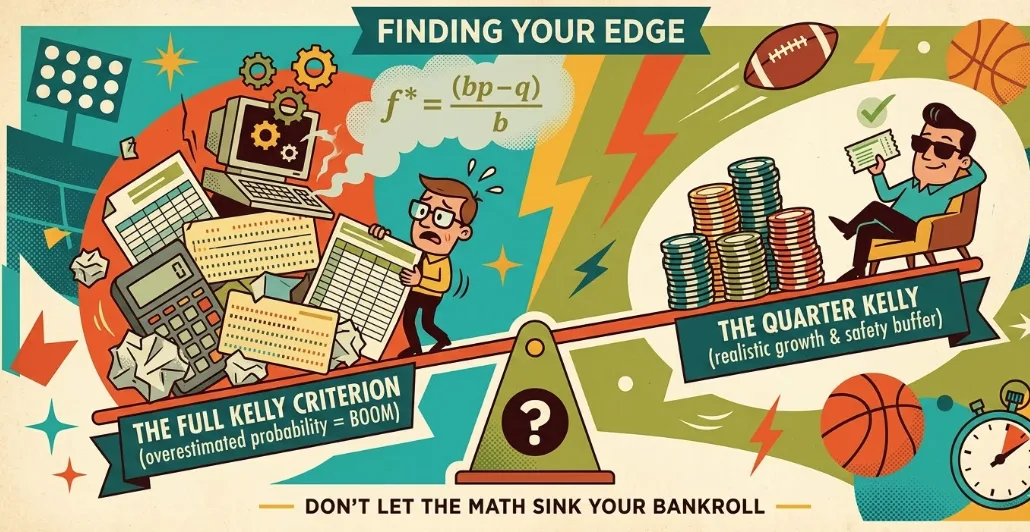
Somewhere in the murky overlap between mathematics, gambling, and human overconfidence sits a formula that was never designed for sports betting. It was built to solve a telephone noise problem. And yet, seven decades later, the Kelly Criterion has become the single most discussed bankroll management strategy in serious sports betting circles, name dropped by sharps and weekend warriors alike, usually right before someone blows their entire account on a three team parlay.
So here's the honest question: if you're not Bill Benter sitting in a Hong Kong penthouse running 120 variable horse racing algorithms, is the Kelly Criterion actually worth learning? Or is it just intellectual decoration for recreational bettors who'd be better off sticking to flat unit sizing and a cold beer?
The answer, like most things in betting, is more interesting than a simple yes or no.
Where This Formula Came From (And Why It Matters)
In 1956, a Bell Labs physicist named John Larry Kelly Jr. published a paper with the unassuming title "A New Interpretation of Information Rate." It had nothing to do with gambling. Kelly was working on a problem about maximizing data transmission through noisy telephone lines, trying to figure out how to get the strongest signal through unreliable connections.
But a colleague named Claude Shannon (the man who literally invented information theory and, by extension, the conceptual foundation of the internet) realized Kelly's formula had a much more exciting application. If you replaced "signal" with "edge" and "noise" with "uncertainty," you had a formula that told you exactly how much of your money to risk when the odds were in your favor.
Shannon and a MIT mathematics professor named Edward Thorp took this idea to Las Vegas and used it alongside card counting systems to beat blackjack tables. Thorp later applied it to Wall Street and founded Princeton Newport Partners, one of the most successful hedge funds of its era. Warren Buffett and Bill Gross have both been credited with using Kelly style allocation in their investment strategies.
The formula works. The question is whether it works for you.
The Formula Itself (It's Simpler Than You Think)
Here's what keeps people away from the Kelly Criterion: they assume it requires a mathematics degree. It doesn't. The formula in its basic form looks like this:
f = (bp - q) / b
Where:
f is the fraction of your bankroll you should bet. b is the decimal odds minus 1 (so +150 American odds = 1.5). p is your estimated probability of winning. q is the probability of losing (which is just 1 minus p).
That's it. Four variables. One division. Your phone calculator handles it in about three seconds.
Let's run through a real example. Say you like the Cowboys moneyline at +150 and you believe they have a 45% chance of winning based on your analysis.
b = 1.5 (the profit per dollar wagered) p = 0.45 q = 0.55
f = (1.5 x 0.45 - 0.55) / 1.5 f = (0.675 - 0.55) / 1.5 f = 0.125 / 1.5 f = 0.083
Kelly says bet 8.3% of your bankroll. If your bankroll is $1,000, that's an $83 wager.
Now here's the critical detail: if that formula spits out zero or a negative number, Kelly is telling you not to bet at all. The odds don't justify the risk. For a recreational bettor, this built in "don't touch it" signal might be the most valuable feature of the entire system.
What the Coin Flip Experiment Proved About Human Nature
Before we talk about whether casual bettors should use the Kelly Criterion, let's talk about what happens when they don't.
In 2016, researchers Victor Haghani and Richard Dewey ran a now famous experiment. They gave 61 financially trained participants (these weren't random people off the street; they were quantitative finance students and young investment professionals) $25 each and a coin that landed on heads 60% of the time. Players could bet any amount on any flip for 30 minutes, roughly 300 flips, with winnings capped at $250.
The Kelly Criterion says to bet 20% of your bankroll on heads every flip. Follow that strategy, and you'd have roughly a 95% chance of hitting the $250 cap.
What actually happened? Only 21% reached the maximum payout. A full 28% went completely broke. The average payout was a pathetic $91 on what should have been a $240+ exercise. Eighteen of the 61 participants bet their entire bankroll on a single flip. And here's the part that makes you want to close your laptop and go for a walk: two thirds of participants bet on tails at some point during the experiment. Tails. The side they knew was less likely to come up.
Only five of the 61 participants had ever heard of the Kelly Criterion.
This experiment reveals something uncomfortable about recreational betting: the problem for most people isn't finding edges. It's not destroying themselves once they have one. The Kelly Criterion exists specifically to solve that problem.
Why Most Casual Bettors Should Care (Even If They Simplify It)
Let's be real about who reads articles like this. You're probably not running a sophisticated modeling operation. You're not processing 120 data variables through regression analysis. You're a person who enjoys sports betting, wants to do it responsibly, and wouldn't mind keeping more of your bankroll intact through losing streaks.
Here's where the Kelly Criterion adds genuine value for the recreational bettor, even in simplified form:
It forces you to think about edge before bet size. The single biggest mistake casual bettors make is deciding how much to bet based on how confident they feel, which is an emotional measurement, not a mathematical one. Kelly forces a different sequence: first estimate your actual edge, then calculate your stake. If you can't articulate why you think a team's true probability differs from the implied odds, Kelly gives you nothing to work with. And that's the point. No edge, no bet.
It automatically scales your risk. Small edge? Small bet. Big edge? Bigger bet. This is exactly how professional bettors operate, and it's the opposite of what most recreational bettors do, which is bet the same amount on everything or, worse, bet more when they're chasing losses after a bad day.
It tells you when to sit out. When the Kelly formula returns zero or negative, it's mathematically telling you the bet has negative expected value at those odds. This is worth its weight in gold for the bettor who can't resist throwing $20 on a Thursday night MAC game just because it's on television.
It protects against catastrophic loss. The formula's design prevents you from ever going to zero because the percentage adjusts downward as your bankroll shrinks. If you lose half your bankroll, your next bet is automatically half the previous Kelly amount. It's a built in shock absorber.
The Honest Problems With Kelly for Everyday Bettors
Anyone who presents the Kelly Criterion as a silver bullet is selling you something. The formula has real limitations, and pretending otherwise doesn't help anyone.
The accuracy problem. Kelly requires you to know the true probability of an outcome. In a coin flip experiment, that's easy: it's 60%. In a real NFL game? You're guessing. And not just vaguely guessing. If your probability estimate is off by even a few percentage points, the Kelly output can swing dramatically. Bill Benter himself has said that even the best computer handicapping models can overestimate their edge by a factor of two. If the world's most successful sports gambler admits his probability estimates might be twice as aggressive as reality, where does that leave someone eyeballing a line while eating nachos on their couch?
The volatility problem. Full Kelly betting is aggressive. Mathematically, a full Kelly bettor has a one in three chance of halving their bankroll before doubling it. For comparison, a half Kelly bettor has only a one in nine chance of the same drawdown. That's why even professional gamblers almost never use full Kelly. They use fractional Kelly, typically half or quarter, to smooth out the ride. The math proves that going above full Kelly actually decreases your long term growth rate, which means overbetting isn't just uncomfortable; it's objectively counterproductive.
The psychology problem. The Kelly Criterion assumes you are a perfectly rational actor with no emotional attachment to outcomes. It assumes you won't chase losses, won't get reckless after a big win, won't deviate from the formula because your gut says the Packers are due. In reality, most recreational bettors are doing this for entertainment, and entertainment and strict mathematical discipline coexist about as comfortably as a cat and a bathtub.
The practical calculation problem. To use Kelly properly, you need to run the formula for every single bet. That gets tedious. However, this objection has aged poorly. Free Kelly Criterion calculators are everywhere online now. OddsJam, ProfitDuel, and dedicated tools like kellycriterioncalculator.com let you plug in your numbers and get a bet size in seconds. The math excuse doesn't hold up anymore.
The Practical Middle Ground: Quarter Kelly and the 2.5% Rule
Here's what actually works for recreational bettors who want the benefits of Kelly without the stress of running a hedge fund from their phone.
Use quarter Kelly. Take whatever the full Kelly formula tells you and divide by four. If full Kelly says 8%, bet 2%. You'll still be sizing your bets proportionally to your perceived edge, which is the core benefit of the system. But your bankroll swings will be dramatically smoother. The mathematical trade off is that your bankroll grows more slowly during winning periods. The practical trade off is that you can actually sleep at night during losing ones.
Cap your bets at 2.5% of bankroll, regardless. Professional gamblers typically never exceed this threshold on any single wager. It's not a coincidence. A 2.5% max bet means you can sustain a 40 bet losing streak (which does happen, even to sharp bettors) and still retain meaningful bankroll. Combine this cap with quarter Kelly and you have a system that's both mathematically grounded and emotionally survivable.
Change your client seed. Wait, wrong article. Change your mindset. Stop thinking about bet sizing as "how much can I afford to lose" and start thinking about it as "how much does my edge justify risking." That single reframe, which is the philosophical core of Kelly, will improve your betting more than any tool or tipster service.
Bill Benter's Billion Dollar Proof of Concept
If you want evidence that Kelly style bankroll management works at scale, look no further than Bill Benter. A physics dropout from Pittsburgh, Benter moved to Las Vegas in 1979, cleaned McDonald's restaurants at night for $3 an hour, and spent his free time counting cards at budget blackjack tables after reading Edward Thorp's "Beat the Dealer."
After getting banned from casinos, he pivoted to Hong Kong horse racing. He built a statistical model that analyzed over 120 variables per horse, ran regression analysis to weight each factor, and used the Kelly Criterion to size every bet. Between 1987 and his retirement in 2001, Benter won over $1 billion in cumulative profits. During his peak, his operation was clearing over $70 million a year.
But here's the detail that matters for this conversation: Benter used fractional Kelly, not full Kelly. Even with the most sophisticated horse racing algorithm ever created, he knew his probability estimates weren't perfect. He deliberately bet less than the formula recommended because he understood that the cost of overbetting was more dangerous than the cost of underbetting.
If a man who won a billion dollars thought full Kelly was too aggressive, that should tell you something about how the rest of us should approach bet sizing.
The Bottom Line: Yes, With Caveats
Is the Kelly Criterion worth the math for casual sports bettors? Yes. But not in the way most gambling content presents it.
You don't need to religiously run the formula before every bet. You don't need to pretend your probability estimates are precise to the second decimal. And you absolutely should not use full Kelly unless your edge calculation comes with a doctoral thesis attached.
What you should do is internalize the principle behind it: bet in proportion to your edge, not your emotions. Use a simplified version, quarter Kelly with a 2.5% cap, and let free online calculators do the arithmetic. The mere act of estimating probabilities before placing a bet will make you more disciplined than roughly 80% of the recreational betting public, which is not a made up statistic; it's what the coin flip experiment showed us about how even financially trained people approach favorable odds when left to their instincts.
The Kelly Criterion wasn't designed for sports betting. It was designed for maximizing signal through noise. And when you think about it, that's exactly what a smart bettor is trying to do: pick out the signal of genuine value from the noise of hype, emotion, and lines that have already been sharpened by professional markets.
John Kelly died young, at 41, from a brain hemorrhage on a New York City sidewalk in 1965. He never saw his formula become the bankroll management standard for an industry that didn't fully exist in his lifetime. But the math he left behind has survived every test thrown at it for nearly 70 years.
For a formula that started with telephone static, that's a pretty impressive track record.