 Sportbet.one
  EveryGame
  Bovada
  MyNitro
  Betcoin.ag
  BetUS
BetUS 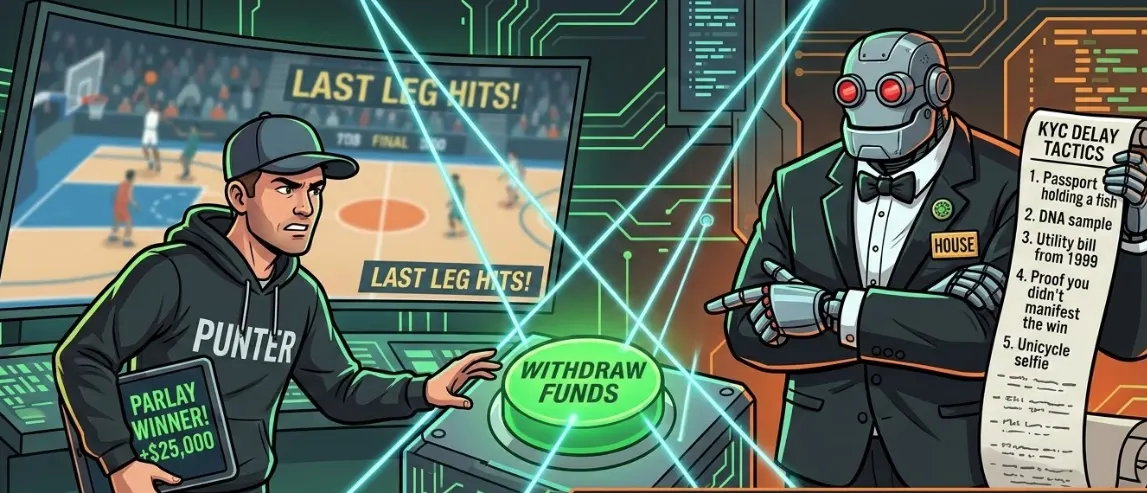
We’ve all been there. You nail a three-team parlay, the last leg hits on a garbage-time layup, and you’re already mentally spending the winnings on a dry-aged ribeye or a down payment on a new ride. But when you hit "Withdraw," the spinning wheel of death greets you, followed by a cryptic email about "Account Review" or "Bonus Abuse." Suddenly, your bankroll feels less like cash and more like Monopoly money.
In the wild world of offshore betting where we often find the best lines, you aren't just a punter anymore. You’ve been drafted as an involuntary debt collector. Here is how to fight back and get your stack.
The "Palpable Error" Trap
The most common excuse for a voided winning bet is the Palpable Error clause. This is the book’s "Get Out of Jail Free" card. If they accidentally list the Lakers at +500 instead of -500, they aren't going to pay you. Legally, most jurisdictions allow books to void bets if the price was clearly incorrect at the time of placement.
Don't waste energy screaming on Live Chat about the sanctity of contracts. If it was a blatant typo, you will lose. However, if the odds were just generous or "stale," you have a case. Save screenshots of the same market on other books to prove their line wasn't an error, just a bad day for their oddsmaker. If three other books had the line at +200 and yours was +250, that is a bad line, not a "palp" error.
Jurisdiction Roulette: Costa Rica vs. Curacao
When playing offshore, your legal recourse depends entirely on where the server sits. Not all hubs are created equal.
-
Costa Rica: Many books here operate under a "data processing license," which is a fancy way of saying they have zero oversight. If a shop in San José stalls, you are in a purely reputation-based fight. You have to make enough noise on social media and affiliate forums that it becomes cheaper for them to pay you than to deal with the radioactive PR.
-
Curacao: This is the middle ground, and it is improving fast. Big names like BetOnline or Bovada are more regulated than you might think. By 2026, the Curacao Gaming Control Board has become much stricter about honoring payouts to maintain their international standing. If you have a legitimate beef over a five-figure withdrawal, filing a formal complaint through the master license holder is your first real power move. It forces a compliance officer to actually look at your file instead of letting a customer service bot give you the runaround.
Beating the KYC "Loop of Doom"
Then there is the KYC Loop of Doom. This is when they ask for a photo of you holding your passport while standing on a unicycle. We call this "KYC stalling." They hope you will get frustrated, cancel the withdrawal, and lose it all back to them in the casino.
Be a compliance ninja. Send high-resolution, uncropped PDFs immediately. If they reject a document, ask for the specific reason in writing. Usually, mentioning that you are documenting this process for a formal complaint to their licensing board makes their "verification software" work perfectly within minutes.
When to Call in the Heavy Hitters
If the amounts get serious, say north of $20,000, it might be time to stop being a punter and start being a plaintiff. You need a Gaming Law Specialist. Firms like Richt Law handle high-stakes gambling disputes by sending Letters of Demand to the book’s corporate registered agent.
Most offshore books want to avoid a legal headache that could jeopardize their merchant processing or their license. While a lawyer isn't worth it for a $500 dispute, for life-changing money, that letterhead is the only key that opens a locked vault.
The "Winner’s Tax" and Affiliate Leverage
Books hate winners. If you win consistently, they will claim you are part of a "betting syndicate" or using prohibited software. This is their favorite way to confiscate funds rather than just limiting your account. To fight this, keep your betting history from other books. If you can show you are just a sharp solo player with a consistent strategy, their syndicate argument falls apart.
Don’t forget the power of Affiliate Leverage. If you signed up through a major review site, they have a direct line to the sportsbook's marketing manager. Sportsbooks pay these affiliates thousands for traffic. If an affiliate tells a book, "Pay this guy or I’m taking you off my Top 10 list," the money usually appears overnight. Use that muscle. Between affiliate pressure and the transparency of 2026 USDT blockchain transactions, you have more tools than ever to ensure the house doesn't just win, but actually pays.