 Sportbet.one
  EveryGame
  Bovada
  MyNitro
  Betcoin.ag
  BetUS
BetUS 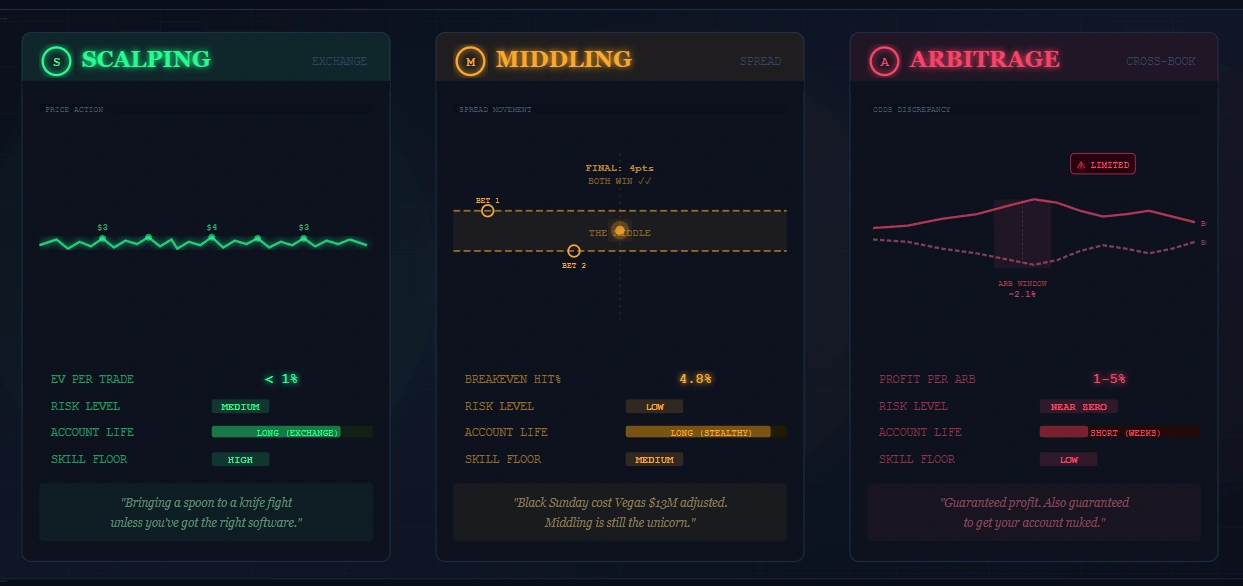
If you have been betting for more than six months and still think "sharp betting" means picking winners, you are reading the wrong articles. The real edge in sports betting has never been about predicting the future. It is about exploiting the present. And three strategies sit at the center of that idea: scalping, middling, and arbitrage.
They sound similar. People on Reddit use them interchangeably. Your cousin who "makes bank on DraftKings" probably confuses all three. But the differences between them are massive, and understanding those differences is what separates bettors who grind out steady returns from bettors who get their accounts gutted to $5 max wagers on coin flips.
Let us break down each one properly.
What Is Scalping in Sports Betting?
Scalping is the art of making tiny, repeated profits from small price movements. Think of it as day trading, except instead of stocks, you are trading odds. A scalper does not care who wins the game. A scalper does not care about injuries, weather, or whether the quarterback had a fight with his wife. A scalper cares about one thing: the price moved, and they were there when it happened.
The strategy originated on betting exchanges like Betfair, where you can both back (bet for) and lay (bet against) an outcome. You place a back bet at one price and a lay bet at a slightly different price. If both orders fill, you lock in a small profit regardless of the result. We are talking one or two ticks of movement. On a single trade, your profit might be three or four dollars. Do it 30 times across a busy horse racing card, and you are looking at $90 to $120 before commission.
Peter Webb, creator of the popular Bet Angel trading software and one of the most respected voices in exchange trading, has described scalping this way: the real objective is not predicting price direction but ensuring a high success rate on individual trades. You are not trying to be right about which horse wins. You are trying to be right about which direction the price twitches in the next 45 seconds.
The Reality Check
Here is the part most "scalping guides" leave out. Scalping in 2026 is significantly harder than it was in 2015. Automated trading bots now dominate exchange markets. These algorithms process information in milliseconds and can match orders before a human being has finished reading the odds. If you are scalping manually against bots, you are bringing a spoon to a knife fight.
Professional scalpers today use dedicated trading software like Bet Angel or Geeks Toy, which enables one-click betting and displays market data in real time. They run low-latency internet connections. Some even co-locate their servers near exchange data centers to shave off precious milliseconds.
The average recreational bettor simply cannot compete at this level. That does not mean scalping is dead for regular people, but it does mean the entry barrier is real. If someone sells you a "scalping course" that promises easy money with no tools, ask yourself the question that veteran trader Toby from Punter2Pro has asked many times: if the method prints money, why are they selling it?
Where Scalping Gets Tricky for Americans
Exchange betting barely exists in the United States. Betfair does not accept US customers. The regulated exchanges that do operate stateside have limited liquidity. So for most American bettors, scalping in the traditional exchange sense is not really on the table. What some US bettors call "scalping" is actually closer to arbitrage: exploiting price differences between two different sportsbooks. We will get to that.
What Is Middling in Sports Betting?
Middling is the unicorn of sports betting strategies. When it works, you win two bets on the same game. When it does not work, you lose only the juice. It is the closest thing to a free lunch that the betting world offers, and it has produced some of the most legendary wins in gambling history.
Here is how it works. You bet one side of a point spread or total early. The line moves. You then bet the other side at the new number. If the final result lands between your two numbers, both bets win. If it does not land in the middle, one bet wins and one loses, and you are out only the vigorish (typically about $10 on a $110 wager at standard -110 odds).
The "Black Sunday" Story That Made Middling Famous
January 21, 1979. Super Bowl XIII. Pittsburgh Steelers versus Dallas Cowboys at the Orange Bowl in Miami. The Steelers opened as 3.5-point favorites. Sharp money hammered Pittsburgh, pushing the line to 4 and then 4.5. At the Stardust casino in Las Vegas, Frank "Lefty" Rosenthal, the real-life inspiration for Robert De Niro's character in the Martin Scorsese film "Casino," ran a promotion letting bettors take Pittsburgh at -3.5 and Dallas at +4.5.
The Steelers won 35 to 31. A four-point margin. Right in the middle.
Every bettor who had both sides cashed both tickets. Las Vegas sportsbooks reportedly lost an estimated $3 million that day, which adjusts to roughly $13.5 million in today's dollars. The industry dubbed it "Black Sunday," and it remains one of only two occasions since the Nevada Gaming Commission began tracking results where sportsbooks lost money on the Super Bowl.
The Math Behind Middling
Here is the cold arithmetic that makes middling viable. Say you bet 21 times on both sides of a wager at -110, attempting a middle each time. Your total outlay is $4,620 (21 games times two bets of $110 each). Every time you miss the middle, you lose $10 in juice but win one side. So your net cost for 20 missed middles is $200 (20 times $10).
If you hit the middle just once, you win $200 on both sides of that game, which is $400. Subtract your $200 in accumulated juice losses and you are up $200. That means you need to hit the middle only about 4.8 percent of the time to break even. In the NFL, where key numbers like 3, 6, 7, and 14 account for a disproportionate share of final margins, hitting a one- or two-point middle is more realistic than you might assume.
Where Middling Shines and Where It Falls Flat
Middling is most powerful in football, where point spreads are integral and certain margins of victory cluster around specific numbers. Since the NFL moved the extra point back in 2015, only four margins of victory have occurred more frequently than about 5 percent of the time: 3, 6, 7, and 14 points. If your middle window includes one of those numbers, your expected value improves dramatically.
In basketball, the distribution of margins is wider and less predictable. A one-point middle in the NBA is rarely worth the juice. But a three- or four-point middle on an NBA total can be viable if you catch a significant line movement.
Middling is weakest on moneylines, where there is no spread to create a gap. The closest moneyline equivalent is arbitrage, which brings us to the final strategy.
What Is Arbitrage Betting?
Arbitrage, or "arbing," is the one strategy on this list that guarantees a profit on paper. You find two sportsbooks offering different enough odds on opposite sides of the same event, calculate your stakes so that no matter who wins, you come out ahead. It is the financial equivalent of buying apples at one store for a dollar and immediately selling them at another store for a dollar fifty.
Here is a simple example. Sportsbook A has the Rams moneyline at +130. Sportsbook B has the opponent at +125. By calculating the implied probabilities (dividing 1 by the decimal odds), you discover the combined total is less than 100 percent. That gap is your profit. Bet the right amounts on each side, and you walk away with a guaranteed return of 1 to 5 percent regardless of the result.
Typical arbitrage margins are slim. Most opportunities fall in the 1 to 3 percent range. Occasionally you will find a 5 percent arb, and once in a blue moon something north of 10 percent appears, usually during live betting when one book is slow to update its odds. Professional arbers who have been at it since the early days of online sports betting report that opportunities have shrunk considerably as sportsbook technology has improved. Lines across major US operators now converge within minutes of each other, leaving fewer and shorter windows.
Why Sportsbooks Despise Arbitrage Bettors
If you read the terms and conditions of any major sportsbook, you will find language about the service being intended for "recreational" use. This is the fine print that gives them the legal cover to limit or ban you for arbing.
During a 2024 roundtable with the Massachusetts Gaming Commission, the first public meeting of its kind, major US operators defended the practice of limiting sharp bettors. A Fanatics representative revealed that nearly half of the customers they limited were actually net losers at the time of their restriction. Let that sink in. You can lose money and still get limited because of how you bet, not whether you win.
Jack Andrews, co-founder of the betting education platform Unabated, shared a striking anecdote during the same proceedings: DraftKings had limited his account so severely that he could only wager $27 on the Super Bowl coin flip. Not exactly the red carpet treatment you expect after seeing their ads during every commercial break.
Sportsbooks detect arbitrage bettors through several signals. Unusual stake amounts (like $147.83 instead of $150) are the most obvious tell. Consistently betting only when there is a profitable edge, hitting lines right before they move, making frequent deposits and withdrawals, and betting exclusively on niche markets or obscure props all raise red flags. Modern sportsbooks use algorithmic detection systems that monitor closing line value (CLV), which tracks whether a bettor consistently gets better odds than the market settles on. Beat the closing line often enough, and your account gets flagged regardless of whether you are actually winning or losing.
The Three Strategies Compared: What You Need to Know
Here is where the rubber meets the road. Let us compare these three approaches across the dimensions that actually matter.
Expected Value (EV)
Scalping offers small but frequent positive EV when executed correctly on an exchange. Your edge comes from speed and market-reading skill, not from predicting outcomes. The expected value per trade is tiny (often under one percent of stake), but volume is the game.
Middling offers negative EV on any individual attempt but positive EV across a portfolio of attempts, provided you target the right key numbers and the middle hit rate exceeds the breakeven threshold. It is a strategy of patience and selectivity.
Arbitrage offers guaranteed positive EV per trade. Every completed arb is a winner. The challenge is finding opportunities, executing before they close, and surviving the inevitable account limitations.
Risk Profile
Scalping carries moderate risk. If one side of your trade does not fill and the market moves against you, you can take a loss. News events (injuries, red cards, falls in horse racing) can blow up a scalp in seconds. The risk is manageable but real.
Middling carries very low risk per attempt. Your worst case is losing the juice on one side, typically around $10 per $110 wagered. The risk is not financial ruin; it is the slow bleed of juice over dozens of unsuccessful middle attempts.
Arbitrage carries near-zero risk in theory. In practice, the risks are operational: one sportsbook voids your bet, a line changes while you are placing the second leg, or the sportsbook's payout cap prevents you from collecting the full amount. These are edge cases, but they happen.
Account Sustainability
This is where things get real.
Scalping on exchanges like Betfair can eventually trigger the Premium Charge, which taxes profitable users at a higher commission rate. But exchange accounts are far more durable than sportsbook accounts. Betfair wants your volume, even if you win.
Middling is one of the stealthiest strategies available. Because you are placing bets on both sides of a line at different times (often days apart), the pattern is much harder for sportsbooks to detect. You look like a bettor who changed their mind, not a calculator with a credit card. Middling is the strategy most likely to keep your accounts alive.
Arbitrage is an account killer. Professional arbers who have been in the game since 2013 describe limiting as not a question of "if" but "when." The most experienced arbers do not try to avoid limitation forever. They try to delay it. They round their stakes, accept bonuses, place the occasional recreational-looking parlay, and deposit gradually rather than in large lump sums. These are survival tactics, not solutions. If you are arbing aggressively across soft bookmakers, expect your account lifespan to be measured in weeks, not years.
Accessibility for Average Bettors
Scalping requires exchange access (limited in the US), dedicated software, fast internet, and significant screen time. It is a skill that takes months to develop and the learning curve is steep. Most novices lose money before they gain consistency. Not ideal for casual players.
Middling requires multiple sportsbook accounts and the discipline to watch line movements. It does not require special software, just sharp attention and an understanding of key numbers. Any recreational bettor with accounts at three or four books can look for middle opportunities. It is the most accessible of the three strategies for the average American sports bettor.
Arbitrage requires multiple funded sportsbook accounts, an odds comparison tool or arb finder service, fast execution, and a solid bankroll (ideally $1,000 or more spread across several books). The mechanics are straightforward, but the operational demands are high.
The Honest Truth About All Three
Only about 3 to 5 percent of sports bettors are profitable over a full year. The sportsbook business model depends on this. The house edge, built into every line through the vigorish, means that even a competent bettor needs a sustained analytical advantage just to break even.
Scalping, middling, and arbitrage each represent a different way to tilt the math back toward the bettor. But none of them is a magic button. Scalping demands technical skill and infrastructure. Middling demands patience and a deep understanding of number distribution in the sports you bet on. Arbitrage demands operational speed and a willingness to manage a constantly shrinking collection of sportsbook accounts.
The sportsbooks know this. They are not charities. Brian Chappell, founder of the UK-based bettor advocacy group Justice for Punters, predicted back in 2018 that account limiting would become a major issue as legal sports betting expanded across America. He was right. Today, US sportsbooks limit bettors not based on whether they win, but on how they bet. Closing line value, bet timing, market selection, and stake patterns all feed into detection algorithms that flag accounts faster than most people realize.
If you take one thing from this article, make it this: the strategy you choose matters less than how you execute it. A sloppy arber gets limited in a week. A disciplined middler can grind quietly for years. A skilled scalper can extract consistent value from volatile exchange markets while the rest of the field watches in confusion.
Pick the strategy that fits your bankroll, your market access, your risk tolerance, and your patience level. Then learn it properly before you risk real money on it.
The books have all the time in the world. Make sure you use yours wisely.