 XBET
 BUSR
 Sportbet.one
 MyBookie
 EveryGame
 Bovada
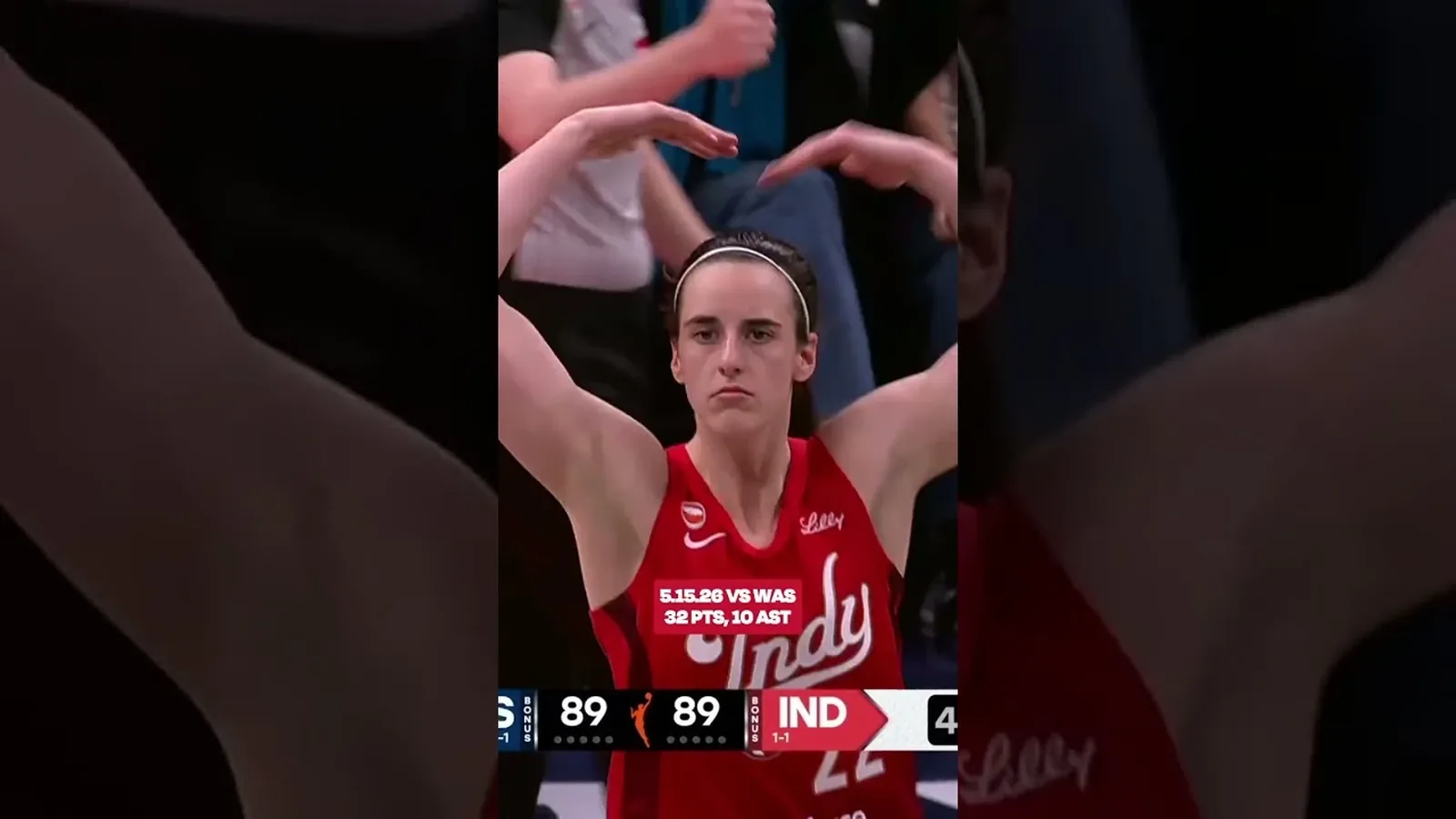
Here is a stat that starts arguments in every WNBA group chat: Caitlin Clark's 3-point percentage over her first three pro seasons is about 34%. In 2026 the league as a whole shot 34.0% from deep. On paper, the most famous shooter in women's basketball is an average 3-point shooter.
And yet nobody who has watched her play believes that. Defenses pick her up at half court. Coaches build game plans around her range. She set the record for the fastest player to 200 career threes. So what gives? The catch is that 3-point percentage measures one thing, and it is not the thing that makes Clark dangerous. Here's the full picture, plus what it means if you bet on her.
Caitlin Clark's 3-point shooting at a glance
- 2026: 114 of 316 from three, 36.1%, in 40 games; the league averaged 34.0%
- Career (2024-2026): about 34% on roughly 775 attempts (our arithmetic)
- At Iowa: 548 threes on 1,452 attempts, 37.7%, the most in NCAA Division I women's history
- Milestone: fastest to 200 WNBA threes, in her 74th game (July 17, 2026)
- The catch: she takes some of the longest, hardest threes in the league, and the threat of them powers everything else
Caitlin Clark's 3-point percentage, season by season
Start with the raw numbers. They are not as bad as the "average" label suggests, but they are not Steph Curry numbers either.
| Season | Games | 3PM-3PA | 3P% | 3PA per game |
|---|---|---|---|---|
| 2024 (rookie) | 40 | 122-355 | 34.4% | 8.9 |
| 2025 (injured) | 13 | 29-104 | 27.9% | 8.0 |
| 2026 | 40 | 114-316 | 36.1% | 7.9 |
| WNBA total | 93 | 265-775 | about 34.2% | 8.3 |
Sources: StatMuse, Her Hoop Stats and Basketball-Reference. The 2024 attempt total and the career line are our arithmetic from the published makes and percentages; StatMuse lists her career mark at 33.8%, so treat the last row as "about 34%".
Two things stand out. First, the 2025 dip. She played only 13 games around injuries and shot 27.9%, which drags the career figure down by more than a point. Second, the 2026 rebound: 36.1% is two points above the league average on nearly eight attempts a night. That is good, not legendary.
Why a "best shooter ever" can have an average 3-point percentage
1. She shoots from where other players won't
The WNBA arc sits 22 feet, 1.75 inches from the rim. Clark's average three in her rookie season was reported at about 26.7 feet, among the longest in league history. A 27-footer is not the same shot as a corner three, and percentage treats them as equal.
The deep ones are not her weak spot either. A 2024 Sports Illustrated breakdown found her shooting 37.5% from 30 to 34 feet and 28.9% from 20 to 24 feet. That sample at 30-plus feet was only about 40 shots, so don't build a bankroll on it, but the pattern is real: her percentage is not being hurt by the logo threes. It suffers more from the contested, short-clock threes in between.
2. Most of her threes are self-created
A spot-up shooter catches a pass with her feet set. Clark usually has the ball in her hands, often off the dribble, often early in the shot clock, and often with the best perimeter defender on her. Pull-up threes are harder than catch-and-shoot threes for every player in every league. The best pure spot-up shooters post higher percentages because their shots are easier, not because they are better shooters.
3. Volume changes the math
A role player who takes three open looks a game can shoot 40%. Clark takes eight, many of them late in the clock when a possession has broken down. More attempts means more bad shots in the mix, and the percentage drifts toward the middle.
Compare shooters on the same shot type. If a stat site offers catch-and-shoot vs pull-up splits, or shot-distance bands, use those. A single 3P% number mixes easy and hard shots together.
What 3-point percentage misses: gravity, points and assists
The math of a three
A three is worth 1.5 times a two. At 36.1%, Clark's threes produce about 1.08 points per attempt. To match that on two-point shots, a player would need to make 54.2% of them. Even at the league-average 34.0%, a three returns 1.02 points per shot, the same as making 51% of twos. Volume threes at an average percentage are still efficient offense.
Gravity: the shot she doesn't take
Because she can score from 30 feet, defenders have to meet her far beyond the arc. That stretches the floor for everyone else. Driving lanes open, the defense rotates, and the pass goes to a teammate for an easier shot. None of that shows up in her 3-point percentage. It shows up in the assist column.
In 2026 Clark averaged 22.3 points (third in the league) and 8.3 assists (second), for 891 points and 333 assists in 40 games. Per Yahoo Sports, she became the first player in WNBA history with 800 points and 300 assists in one season. As a rookie she had already set the single-season assist record with 337, along with a rookie-record 122 threes, according to NBC's 2024 season review.
True shooting tells a different story
True shooting percentage blends twos, threes and free throws into one efficiency number. Mid- to late-season reports in 2026 had Clark at about 60% (Sports Illustrated cited 60.3%, Yahoo 60.6%). That is the profile of an efficient primary scorer, which 3P% on its own hides.
Claim Bonus Now →
The case that she really is an elite shooter
Iowa: the biggest sample we have
At Iowa she made 548 threes on 1,452 attempts, a 37.7% clip, and scored 3,951 points, both NCAA Division I women's records. Her 2023-24 season was full of logo threes against defenses built to stop exactly that. The college sample is twice the size of her pro sample.
The fastest 200 in WNBA history
On July 17, 2026 against Seattle, Clark made her 200th career three in her 74th game, beating Katie Smith's record of 81 games. She finished that night with 45 points and 10 assists, the first 40-point, 10-assist game in league history, in a 110-107 Fever win (AP via WTOP). Speed to a milestone is a volume-and-make stat, and volume is the point.
Range and release
"Best shooter" in the popular sense means range, a quick release and the ability to make a hard shot under pressure. On those terms Clark is near the top of any list. On pure catch-and-shoot accuracy, other WNBA players beat her. Both statements can be true.
When a debate turns on one percentage, ask three questions: how many attempts, how hard were the shots, and what else did the threat of the shot create? A 36% shooter on eight deep threes a game can be worth more to an offense than a 42% shooter on two open ones.
Where the criticism is fair
None of this means 3P% is irrelevant. Her 2025 shooting was poor, even allowing for the injuries. Her pro percentage is below her college mark, as you'd expect against longer, faster defenders. And her style carries a cost: in 2026 she was reported to lead the league in turnovers, part of the same high-risk, high-reward approach that produces the assists and the deep makes.
The fair verdict: Clark is a good, high-volume 3-point shooter whose percentage is held back by shot difficulty, and whose value comes from what the threat of the shot does to a defense. "Average 3P%" is true. "Average shooter" is not.
What Caitlin Clark's 3-point percentage means for betting props
Threes made props depend on volume, not percentage
The most common shooting prop is "3-pointers made", set at a half number like 2.5. For an over, attempts matter as much as accuracy. In 2026 she took 7.9 threes and made 2.85 a game (114 in 40).
Here is a simple model, treating each shot as an independent 36.1% chance (our arithmetic; real shots are not fully independent):
| 3PA in the game | Expected makes | Chance of 3+ makes | Break-even odds |
|---|---|---|---|
| 7 | 2.53 | 49.3% | +103 |
| 8 | 2.89 | 59.8% | -149 |
| 9 | 3.25 | 68.8% | -221 |
One extra attempt moves the chance of an over 2.5 by about ten points. So before you bet the over, ask what drives her attempts that night: minutes, pace, the opponent's scheme, and whether the game could turn into a blowout that ends her night early.
Variance is huge
Her season finale in 2026 was a two-point game with no made threes. Her best night was 45 points. A 36% shooter on eight attempts will miss the over about four times in ten even when everything goes to plan. Size the stake for that; our Kelly criterion guide shows how.
Combine smartly
Clark's threes and assists are connected: when defenses run her off the line, the assists go up and the threes go down. Stacking "over threes" and "over assists" in a same-game parlay can be working against itself. In-game, you can watch how the defense plays her before you act; our live betting guide explains the timing.
The 2026 WNBA season is over, and books post player props only for scheduled games. Use these numbers as a framework when the 2027 season starts, and check her attempts over the most recent games before betting a line.
Put it to work
When the WNBA returns, player props on threes, points and assists are on the board at the books below. MyBookie is our featured pick; Bovada and BUSR are good second accounts for comparing prop lines. Check the promo page for current welcome offers.
The legal side
Offshore sportsbooks are not licensed by any US state, and your state's law decides whether you may use one. Sports betting is 21+ in most states, and gambling winnings are taxable. Our offshore sportsbooks guide has the details.
Bet only what you can afford to lose. If betting stops being fun, see our responsible gambling page, call 1-800-GAMBLER or visit ncpgambling.org.